Center for Hybrid Intelligence · Temple University

Artificial intelligence, built to work with people

The Center for Hybrid Intelligence (CHI) is Temple University’s home for artificial intelligence research. Our faculty advance the core of modern AI — language models, computer vision, machine learning and optimization, knowledge graphs, and reasoning — with a particular focus on human–AI collaboration and human-centered AI: systems in which people and machines together do what neither could do alone.

We use hybrid intelligence as an intentionally broad idea. Useful intelligence is often distributed across algorithms, data, people, and knowledge of the domain, and many of the most interesting AI problems appear where these meet: how people and models should share a task, how AI should be designed around the people who use it, and how it can bring together knowledge from many sources.

CHI is based in the College of Science and Technology, with its core faculty in the Department of Computer and Information Sciences, and works with collaborators across Temple, the Philadelphia region, and industry. If you are at Temple and your question involves AI, CHI is the place to start.

Center for Hybrid Intelligence

Temple University

Director
Slobodan Vucetic, Professor of Computer and Information Sciences
Core faculty
Eduard Dragut · Hongchang Gao · Longin Jan Latecki · Stephen MacNeil · Slobodan Vucetic · Pei Wang
Affiliated faculty
Collaborators across Temple University — see below
Home
College of Science and Technology
Contact
chi@temple.edu

Recent highlights

Selected recent activity at the Center

Active funding National Science Foundation · National Institutes of Health · HHS · Department of Education · industry and foundations Papers at ICML, NeurIPS, IJCAI, AAAI, CHI, CSCW, WACV, EMNLP, ACL, NAACL, COLM, WWW, VLDB
  • 2026 Stephen MacNeil receives the Dean’s Distinguished Teaching Award, and students from his HCI lab win NSF Graduate Research, Paul & Daisy Soros, and Goldwater fellowships. Temple HCI Lab
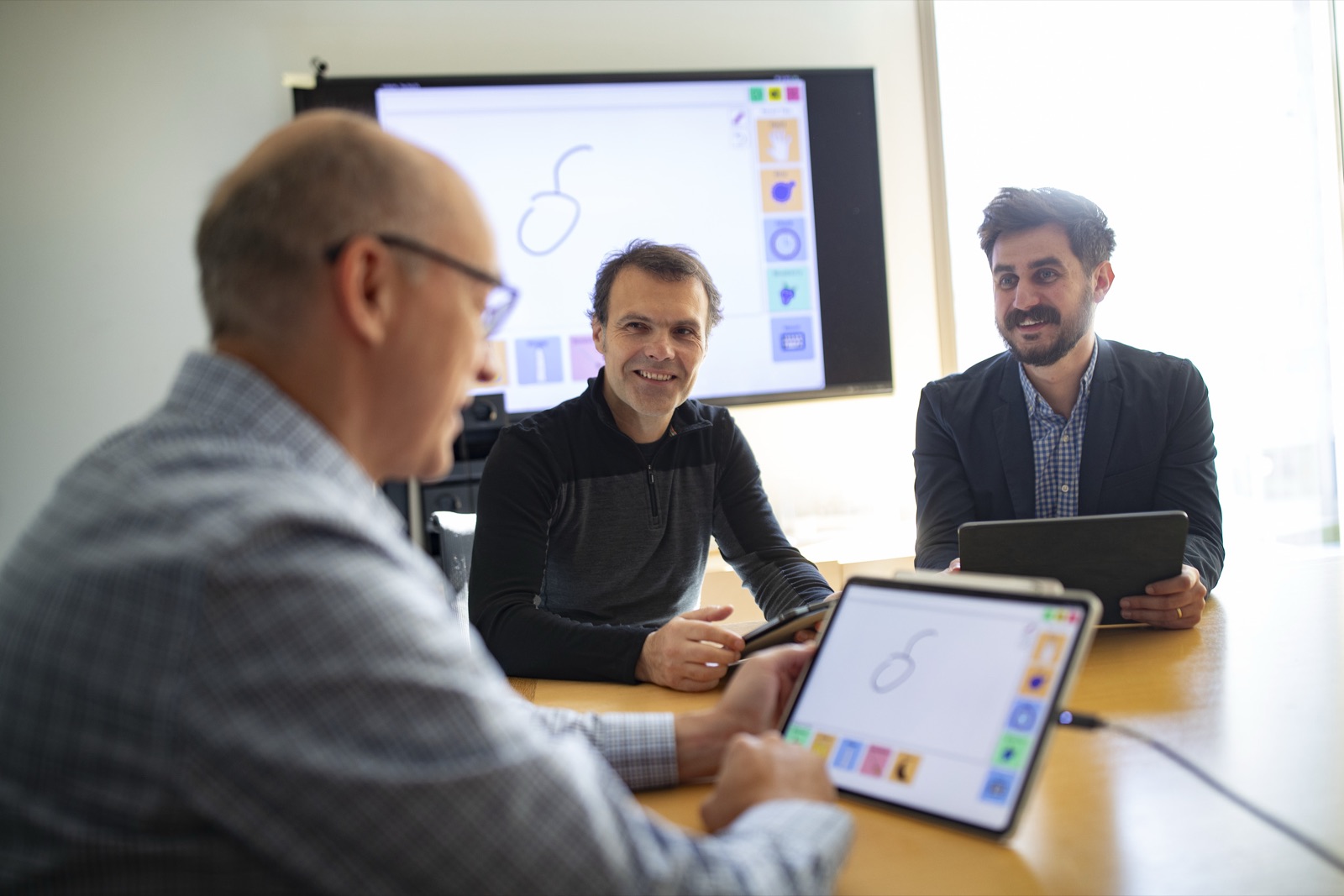
  • 2025 Rehabilitation Engineering Research Center on AAC — a five-year, $4.8M NIDILRR center led by the University of Arkansas with Florida State, Auburn, Penn State, and Temple. CHI faculty Stephen MacNeil, Eduard Dragut, and Slobodan Vucetic lead its AI research, with $1.5M coming to Temple, continuing the team’s NSF Convergence Accelerator project on AI-powered AAC (2022–2024). Temple News · Announcement · NSF Convergence Accelerator
  • 2025 Pei Wang, one of the founders of the field of artificial general intelligence, is interviewed by Japan’s NHK about his NARS reasoning system and featured on Temple’s Owl Byte podcast. NHK interview · Podcast
  • 2024 Hongchang Gao receives an NSF CAREER award for decentralized federated learning, which trains AI models across institutions without sharing private data. Award page
  • 2023 Eduard Dragut and Longin Jan Latecki lead ClimatePub4KG, an NSF Proto-OKN project that uses language models to build an open knowledge graph of climate models, data, and tasks from the scientific literature. Project · Award page · NSF Proto-OKN
  • 2021 Slobodan Vucetic and Hongchang Gao lead an NSF project on data augmentation and adaptive learning for next-generation wireless spectrum systems (2021–2026). Award page
  • 2020 NSF Future of Work project on personalized virtual job assistants for people with neurodevelopmental disabilities ($2.3M; Vucetic, Dragut, and Temple colleagues Donald Hantula and Matthew Tincani) launches CHI’s research on AI for autistic job seekers, followed in 2024 by an NSF planning grant for a Center for Neurodiversity Development and Advancement. Temple News · Future of Work award · Planning grant
  • 2020–24 Eduard Dragut and Slobodan Vucetic co-organize five editions of DaSH, the Workshop on Data Science with Human in the Loop, at KDD, NAACL, and EMNLP. Proceedings
Research

Three questions about human and machine intelligence

Fields
  • AI and machine learning
  • Human-computer interaction
  • Natural language processing
  • Computer vision
  • Knowledge graphs and reasoning
  • Optimization
  • Data management

Hybrid intelligence asks how human and machine intelligence can be combined. Three questions organize most of our work.

How should people and AI contribute complementary intelligence?

People bring knowledge, judgment, goals, and context; AI brings scale, speed, and pattern recognition. We study how the two should share a task: putting people in the loop where they add the most, evaluating AI with and by the people who rely on it, and learning when human-provided labels are themselves imperfect.

Methods. Human-in-the-loop learning · human evaluation of AI · learning from imperfect labels · interactive extraction and annotation.

How can AI be designed around the people who use it?

AI is most valuable when it expands what people can do. We build and study human-centered AI with the communities it is meant to serve: communication technology for people who use AAC, support for autistic job seekers, and generative AI in computing education and assessment.

Methods. Human–AI interaction · accessibility and assistive computing · participatory design · computing education · generative AI.

How can AI combine different forms of knowledge?

The information needed to solve a problem rarely exists in one place. It may be distributed across language, images, structured records, measurements, knowledge bases, simulations, and human expertise — as in our NSF Proto-OKN project, which organizes the climate-modeling literature into an open knowledge graph.

Methods. Information extraction · knowledge graphs · multimodal and representation learning · knowledge-aware models · reasoning.

Representative projects

Interdisciplinary work, in concrete terms

Partners Communication sciences · disability research · behavioral science · special education · climate science · wireless engineering · medicine.
Communication and accessibility

Keeping the person communicating in control

CHI researchers work with collaborators in communication sciences and disability research on augmentative and alternative communication technologies. The work combines AI with participatory design and expertise from people who use AAC, asking how intelligent systems can make communication more flexible and context-aware without removing control from the person communicating.

Neurodiversity and employment

Designing around lived experience

CHI researchers have studied how AI and interactive technologies can support neurodivergent people in employment-related settings. This work brings machine learning and human-computer interaction together with behavioral science, special education, and direct study of the experiences of autistic and neurodivergent workers and job seekers.

Scientific knowledge

A knowledge graph for climate modeling

Climate research produces a vast literature of models, datasets, and experiments that is hard to search and reuse. ClimatePub4KG, part of NSF’s Prototype Open Knowledge Network, uses language models and information extraction to turn publications into an open knowledge graph linking papers, data, models, and tasks — so researchers can find and build on what already exists.

Privacy-preserving AI

Learning from data that cannot be pooled

Hospitals, companies, and devices often hold data that cannot leave their hands. Federated and decentralized learning trains shared AI models without moving the raw data. CHI research develops the optimization algorithms and theory that make this efficient and reliable, with applications from healthcare to wireless systems.

People

Complementary expertise

Students Students join CHI research through the laboratories and research groups of individual faculty. Growth CHI continues to grow through new core faculty, an expanding affiliate membership, and collaborations with regional institutions, industry, and nonprofits.

Core faculty

Slobodan Vucetic

Slobodan Vucetic Director

Computer and Information Sciences

Human-centered AI, machine learning, biomedical informatics, data science.

Eduard Dragut

Eduard Dragut

Computer and Information Sciences

Information retrieval and integration, natural language processing, knowledge graphs.

Hongchang Gao

Hongchang Gao

Computer and Information Sciences

Machine learning and optimization, including federated, distributed, and decentralized learning.

Longin Jan Latecki

Longin Jan Latecki

Computer and Information Sciences

Computer vision, machine learning, knowledge graphs, medical imaging.

Stephen MacNeil

Stephen MacNeil

Computer and Information Sciences

Human-computer interaction, human-centered AI, accessibility and AAC, computing education.

Pei Wang

Pei Wang

Computer and Information Sciences

Artificial intelligence, artificial general intelligence, reasoning under uncertainty.

Affiliated faculty Collaborators across Temple University

Marcus Bingenheimer

Religion

Natural language processing, philosophy of AI.

Donald Hantula

Psychology

Behavioral science.

Benjamin Seibold

Mathematics

Applied mathematics, simulation.

Geoffrey Wright

Public Health

Cognitive neuroscience.

Collaborate

Temple’s first stop for AI

Start here chi@temple.edu Where our work has gone Health and biomedicine · accessibility and communication · education · climate and environmental science · materials and chemistry · wireless and cybersecurity · transportation and robotics · industry and finance.

AI is reshaping every field at Temple, and most people with an AI question do not need a laboratory of their own — they need the right collaborator. CHI faculty cover the breadth of modern AI, from language models and computer vision to optimization, knowledge graphs, reasoning, and human-computer interaction. What we add is the hybrid-intelligence perspective: AI designed to work with the people who use it, and evaluated where it is actually used.

Temple researchers

If your research could use AI, talk to us first. We help colleagues turn questions into AI projects, build joint proposals, and find the right faculty and students — from a single conversation to a multi-year grant. Our joint work already spans communication sciences, special education, psychology, medicine, public health, and climate science.

Industry, government, organizations

Organizations of every size are looking for AI expertise they can trust. CHI offers the depth of a research university and the attention of a center that wants to work with you: faculty who build and evaluate AI together with the people who will use it, students trained in current methods, and a record of sponsored projects with companies, federal agencies, and nonprofits. Sponsored research, prototypes, student projects, and long-term partnerships are all possible.

Students

CHI faculty recruit Ph.D. students each year across machine learning, NLP, computer vision, optimization, and human-centered AI, and many undergraduates do research in our labs. CHI students have gone on to NSF Graduate Research, Soros, and Goldwater fellowships, faculty positions, and research roles across the AI industry. Temple CIS Ph.D. program